What Is CREST?
The CREST (Comprehensive Research Evidence Synthesis Training) Center is a program designed to help students, clinicians, and researchers learn how to carefully evaluate and summarize scientific evidence.
In healthcare, there is often a lot of information available, but not all of it is reliable or easy to interpret. CREST teaches people how to conduct systematic reviews—structured, rigorous studies that gather and assess all the available research on a given topic—so that decisions can be based on the best possible evidence.
The goal of CREST is to build a community of learners who can contribute to high-quality research and improve patient care. By pairing trainees with experienced mentors and involving them in real research projects, CREST aims to make these skills practical and accessible. Over time, this helps strengthen the overall quality of evidence in fields like complementary and integrative medicine.
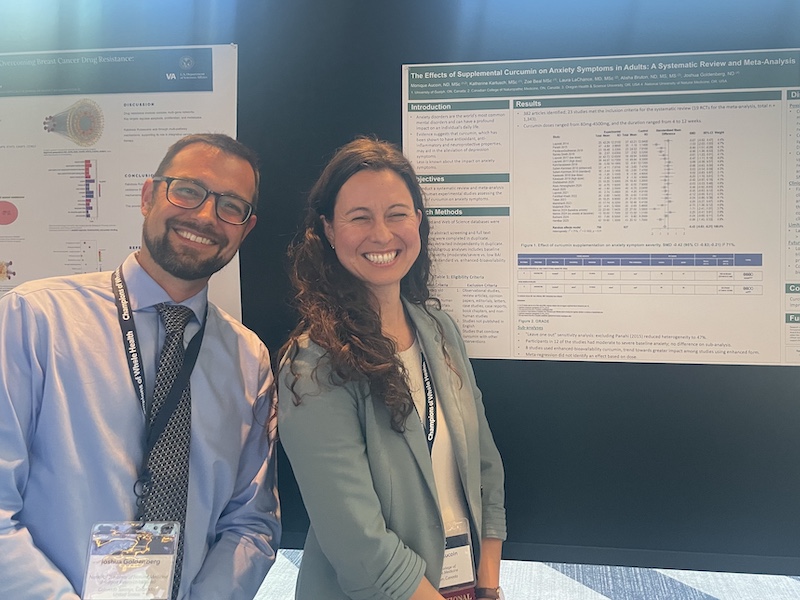
NUNM’s Jayme Barnes sat down with Joshua Goldenberg, ND, PhD(c) a clinician–scientist and research leader specializing in evidence synthesis serving in a senior research leadership role at NUNM’s Helfgott Research Institute, to learn more about CREST, its work, and how this approach is pushing naturopathic medicine forward.
Jayme Barnes (JB): What is the CREST program?
Joshua Goldenberg (JG): In modern medicine, there’s a concept called evidence-based medicine—the idea that we should make clinical decisions based on the best available evidence.
If you’ve seen the hierarchy of evidence, at the very top are systematic reviews and meta-analyses. These sit at the top because they don’t rely on a single study; instead, they take all the available research on a question—say, whether a drug works for pain—and synthesize it to give us a clearer, more reliable answer about whether it works, how well it works, and under what conditions.
This approach really took hold in the 1990s and was an important shift for the field. But there’s a growing problem. The number of systematic reviews being published has increased dramatically, yet a large proportion of them are low quality.
I would estimate that around 80% are not just suboptimal, but critically flawed—meaning clinicians and guideline developers can’t rely on them.
The issue is even more pronounced in complementary and integrative health fields—like naturopathy, chiropractic, acupuncture, and whole-person care—where less than 1% of published systematic reviews meet high-quality standards.
So we’re in a situation where the type of evidence we depend on most is often not trustworthy. A major reason for this is training. Many people conducting these reviews haven’t been adequately trained in the methods. Existing training programs tend to be limited—they may not be accessible to students, may not be virtual or flexible, or may not provide hands-on experience.
That’s the gap CREST is trying to fill. The CREST Center is a virtual training program focused on systematic reviews and evidence synthesis. We combine structured coursework with hands-on experience, pairing trainees with both methods experts and content experts and embedding them in real, ongoing systematic reviews.
Right now, we have over 20 active reviews, around 90 participants in our educational programming, and more than 30 student mentees actively contributing to projects. The goal is to build capacity—to train people to produce high-quality evidence so that, over time, the foundation we’re relying on in clinical decision-making becomes more trustworthy.
JB: What motivated the creation of the CREST program? How has its mission evolved?
JG: My initial motivation for CREST really came out of my interest in forensic medicine—this intersection of law, research, and clinical care.
One of the things that becomes very clear when you work in that space is that, while medicine has made a meaningful shift toward evidence-based practice over the past few decades, the legal system is still far behind.
In court, it’s still common for experts to rely heavily on authority—credentials, experience, reputation—rather than systematically synthesized evidence. If someone stood up at a medical conference and said, “Trust me, I’m an expert,” without presenting data, they would be laughed out of the room. But that dynamic still exists in legal settings.
So part of the original goal was to contribute to a more evidence-based approach in the courtroom, particularly in neurotrauma, which is an area my colleague Dr. Batson and I work in extensively. Brain injuries—ranging from concussion to more severe trauma—have long-term consequences, and the evidence base informing these cases is often inconsistent or low quality. We saw a need to systematically synthesize that evidence in a rigorous way.
From there, the educational component emerged somewhat organically. We began building a training structure around how to conduct high-quality systematic reviews, and students started joining. Early on, we received a small pilot grant from the RAND REACH Center, which helped us get the program off the ground. As participation grew—eventually involving multiple institutions—it became clear that the need extended well beyond neurotrauma.
Since then, the mission has broadened considerably. What started as a relatively focused effort has expanded into a larger training and research ecosystem. We now have collaborations with groups like the Canadian College of Naturopathic Medicine, where there’s a dedicated focus on nutrition and behavioral health, including questions around diet and mental health outcomes.
We’ve also developed areas focused on forensics, behavioral health, and emerging work in AI-supported evidence synthesis, with plans to expand into additional domains such as Chinese medicine.
At the same time, there’s been increasing external validation. We’ve had discussions with academic librarians and research leaders at major institutions who specialize in systematic reviews, and the consistent response is that this kind of structured, mentored, and scalable training model is unique. More recently, we’ve had institutions approach us directly asking whether we can train their PhD students in systematic review methods because they don’t have the internal capacity to do so.
So the mission has evolved from a relatively targeted effort in forensic neurotrauma to something broader: building infrastructure and training capacity for high-quality evidence synthesis across multiple fields. The underlying problem remains the same, but the scope of the solution has expanded significantly.
JB: What differentiates the CREST program from other research training programs that are focused on systematic reviews and meta-analysis?
JG: I think there’s a few major ones. One of the things that differentiates CREST is that we provide an A-Z training on how to do systematic reviews. It’s not just big picture theory.
We have a tiered mentorship model where peer captains help new students, we have method leads, and we have method experts at our different institutions, including NUNM, and then we have leadership.
Everyone is getting peer and expert-level mentorship throughout their experience. That is completely unique. I don’t know anyone else doing that.
We’re also very student-focused. We have loads of students and clinicians who are interested in what we’re doing. We’re very open to bringing people in from different organizations. It’s a community. I think that’s very unique for us.
JB: How does Crest elevate NUNM’s profile as a research driven institution?
JG: I think there are a few ways CREST contributes to elevating NUNM’s profile as a research-driven institution.
First, although CREST is growing as its own program, its academic home is clearly at NUNM. That’s where I’m based, where the program is directed, and where a large portion of our trainees are coming from. At the same time, we’ve built meaningful collaborations with other institutions—like the Canadian College of Naturopathic Medicine — so there’s a broader network, but NUNM remains central to the program’s identity.
Second, the majority of our trainees and mentees are NUNM students. Many are part of the research master’s program and are using CREST as a practical, hands-on component of their training. Others are students who want exposure to research but don’t have a clear entry point — CREST gives them a structured and accessible way to get involved in real projects.
What that translates to is capacity building. We’re training a cohort of NUNM students in rigorous research methods—particularly systematic reviews and evidence synthesis—that are highly valued across academic medicine. As these students contribute to publications, their individual CVs improve, but it also reflects back on the institution. Over time, as CREST produces more high-quality systematic reviews and meta-analyses, NUNM becomes more visible as a place that is actively generating and supporting credible research.
So it’s not just about affiliation—it’s about developing people, producing publishable work, and creating a sustained output of higher-quality evidence that strengthens the institution’s research reputation.
JB: For students considering NUNM, what does the existence of a program like CREST say about the university’s commitment to rigor, research, literacy and academic excellence?
JG: At its core, NUNM is a clinician training institution. We’re training naturopathic doctors, nutritionists and Chinese Medicine practitioners, etc.
And the world we live in is a world of evidence-based medicine and evidence-based natural medicine. And we cannot do that well without high-quality, high-tier evidence synthesis. CREST is what this brings to the table.
Years ago, I published a systematic review and meta-analysis on using probiotics to prevent C. difficile infections in people who were taking antibiotics.
About six months later, I got an e-mail from a researcher in Norway who told me that the study was now impacting the guideline discussions for how they use probiotics in their country.
And then years later, a colleague that I met in Denver — a chief pharmacist at one of the hospitals there — said, “Just so you know, we’re deciding how to use probiotics for all of our doctors. We looked at that systematic review and that’s going to inform our practice.”
So that’s the kind of impact that these sorts of systematic reviews can have. I have every expectation that everything that comes out of CREST is at that quality, and we’re going to begin to see that level of impact on medicine and the way it’s practiced.
JB: How can current or prospective NUNM students engage with CREST during their academic journey?
JG: We have multiple ways of getting involved.
Once a month there is some sort of presentation from a national or international expert on topics related to CREST projects that are open for everyone to see and NUNM students are actively invited to watch. Those are always recorded and available asynchronously.
We also have a methods meeting every two weeks that everyone is welcome to join. We call it Evidence Synthesis Lab, and that’s where we go through the different aspects of learning how to do a high-quality systematic review. We have about 90 people right now that participate.
We have about 20 active systematic reviews right now where you can literally get plugged-in, hands-on training and mentorship on how to do systematic reviews.
I think that the main reason CREST has such a strong mentorship model, including mentoring the mentors, by the way, is because of Heather Zwicky, who is the Vice President of research at NUNM. She is an expert in mentorship.
That is one of her areas of expertise. She herself is a stellar mentor. She has studied it formally. She’s been trained, has led training, and has imbued that in everything that we do.
That is very unique to NUNM and to the CREST program, as well.
JB: Why does CREST matter to someone’s education at NUNM?
JG: Any clinically based program—including at NUNM—expects students to read research and apply it to patient care. To do that competently, you need at least a working ability to critically evaluate the literature. That’s something students are introduced to in coursework, but CREST takes it further.
What CREST offers is a much deeper, hands-on experience. When you’re involved in a systematic review, you’re not just reading papers—you’re going study by study, assessing methodology, identifying bias, and really interrogating the quality of the evidence. You’re essentially working “under the hood” of the research process in a way that’s difficult to replicate in a standard classroom setting.
That kind of training changes how you engage with evidence. It strengthens your ability to distinguish between stronger and weaker studies and to apply findings more appropriately in clinical decision-making. So in practical terms, CREST complements the existing curriculum by giving students a more rigorous and applied understanding of how to evaluate and use research during their time at NUNM.
Interested in learning more about CREST, its studies and how NUNM students and faculty are pushing systematic reviews and evidence synthesis training forward?
Visit crestevidence.org to learn more.