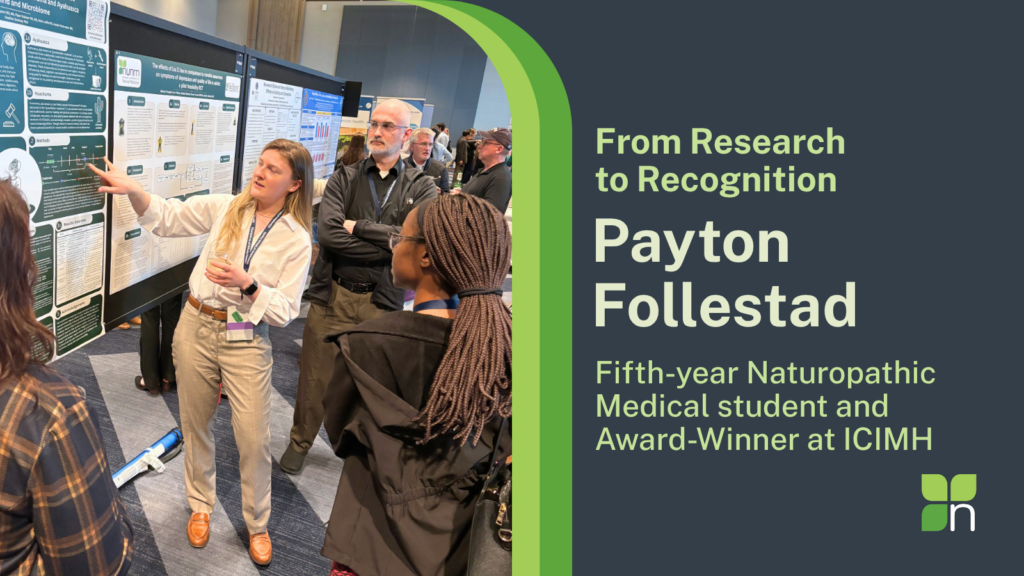
Payton Follestad’s Award-Winning Poster at ICIMH
When fifth-year naturopathic medical student Payton Follestad traveled to the International Congress of Integrative Medicine and Health (ICIMH), she brought with her research she believed in and was proud to share. Presenting alongside a wide range of clinicians and researchers, Follestad highlighted findings from a recent study exploring the relationship between the gut microbiome and psychedelic medicines, to support mental health. Her work resonated and earned recognition at one of the field’s leading integrative medicine conferences.
“I was honestly just excited to be there,” she says. “It’s such a unique space where so many different types of providers come together to talk about whole-person health.”
Presenting and Being Recognized at ICIMH
ICIMH draws a diverse audience, including MDs, DOs, naturopathic physicians, nurse practitioners, and more. For Follestad, it was an opportunity not only to present research, but to listen, ask questions, and better understand where the integrative field is heading.
As part of the conference, Follestad was selected to present in a competitive poster symposium, where researchers share their work in a visual format and engage directly with attendees in one-on-one conversations. These sessions are designed to foster dialogue, allowing clinicians and researchers to dig deeper into methodology, findings, and real-world application.
Her poster went on to receive top recognition in its category, an award that reflects both the quality of the research and the ability to communicate complex ideas clearly to a diverse clinical audience.
A Closer Look at the Gut-Brain Connection with Psychedelics
The research Follestad presented was originally published in December 2025 and centers on a question that continues to gain attention: Is the gut influencing the mental health effects of psychedelic medicine?
Her study examined changes in the gut microbiome and mental health markers in a participant before and after engaging with two traditional psychedelic plant medicines, Ayahuasca and Huachuma (San Pedro cactus). While the study focused on a single participant, the findings revealed notable shifts.
“We saw movement toward a more anti-inflammatory state in the gut,” Follestad explains. “That’s interesting because inflammation is often associated with depression. It raises questions about whether changes in the microbiome could be part of what’s supporting mental health improvements in people taking psychedelics.”
She also observed differences between the two medicines. Ayahuasca appeared to create more dramatic shifts in microbial composition, while Huachuma showed more subtle, widespread changes. In both cases, the overall trend pointed in a similar direction.
“It’s early research,” she emphasizes. “But it gives us something to build on.”
Beyond the Microbiome
Follestad’s work does not stop there. She and her team are preparing to submit additional research that expands into epigenetics, looking at how gene expression may change before and after these psychedelic experiences, and whether those changes persist.
In preliminary findings, the study team is identifying unique patterns in epigenetic and microbiome changes that may help to explain the reported durable antidepressive effects of Ayahuasca.
“That’s what’s really exciting,” she says. “We’re starting to see that there may be longer-term changes happening, not just short-term effects, that extend beyond the pharmacological effect.”
While the sample size is small, the consistency of these early signals is enough to prompt further investigation.
Finding Direction Through Experience
Follestad’s path into this research area was not purely academic. Before coming to NUNM, she was interested in pharmaceutical development, with a focus on creating medications that could have a broad impact. Over time, that path began to feel limiting.
At the same time, she was navigating her own mental health challenges.
“I followed the conventional route, therapy and medications, and it helped to a degree,” she says. “But I still felt like something was missing.”
After learning about traditional psychedelic plant medicines, she chose to explore that path herself. The experience shifted her perspective, both personally and professionally.
“It opened up a completely different way of thinking about healing,” she says. “And it made me want to understand it more deeply.”
That curiosity eventually led her to naturopathic medicine and to NUNM.
“I remember finding the program and thinking, this is how I can bring all of these interests together, science, research, and a more holistic framework.”
Asking Better Questions
For Follestad, research is less about proving a single outcome and more about expanding what is possible to study.
“There’s still so much we don’t understand,” she says. “Why do some people experience long-lasting changes in mental health after a single psychedelic experience? What is actually happening in the body?”
Her work focuses on exploring those mechanisms, whether through the microbiome, inflammation, or gene expression, while recognizing the complexity of each individual’s experience.
She is also thoughtful about the broader context.
“These are powerful interventions, and they are not accessible or appropriate for everyone,” she says. “That’s why it is important to approach this work carefully and responsibly.”
A Growing Area of Inquiry
As interest in whole-person approaches to mental health continues to grow, research like Follestad’s adds to a developing body of knowledge that spans disciplines.
Her award-winning poster is one piece of that larger conversation, one that aims to learn from traditional practices and create collaborative bridges with modern science.
“There’s a lot of curiosity in this space right now,” she says. “And I think that’s a good thing. It means we’re paying attention.”