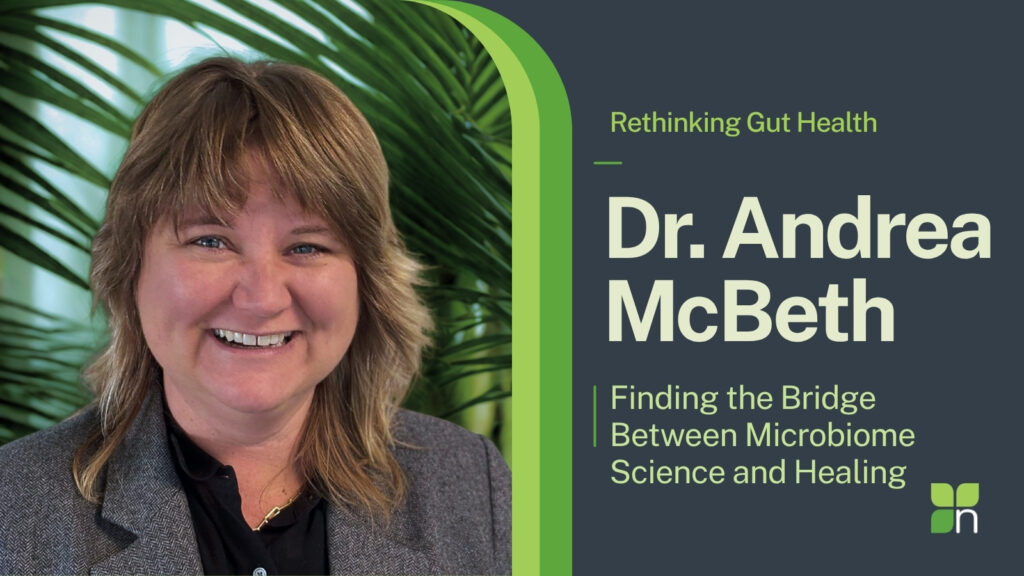
How NUNM Alumna Andrea McBeth, ND is Bringing Microbiome Science into Practice
Dr. Andrea McBeth did not begin her career expecting to enter naturopathic medicine. Raised in Portland, Oregon, she was already embedded in conventional science, working toward a PhD at Oregon Health & Science University with a focus on biomedical engineering and molecular biology. Her path was firmly set in academic research.
That trajectory shifted in a personal way when her sister was diagnosed with non-Hodgkin’s lymphoma.
During her sister’s treatment, she spent long stretches in the hospital and found herself in conversations with a member of the naturopathic community. Those discussions opened a door she had not previously considered. Although she had encountered naturopathic doctors and integrative practitioners growing up in Portland, she had never fully understood the field.
“I didn’t know what naturopathic medicine was,” she says. “Even though I grew up in Portland.”
At the time, she assumed she would return to academia. Instead, she found herself reconsidering everything.
That shift ultimately led her to enroll at National University of Natural Medicine, a decision that would redefine her scientific interests and her career.
Finding the Bridge Between Science and Healing
With a strong foundation in biochemistry and molecular science, Dr. McBeth approached naturopathic medicine with a researcher’s mindset. She was drawn to understanding mechanisms, not just outcomes, and began looking for the biological underpinnings behind the therapies she was learning.
That search led her to the microbiome.
As research in the field expanded, she began to see patterns connecting gut ecology to broader questions of health and disease. Nutrition and lifestyle interventions, along with traditional healing approaches she was learning in school, started to make more sense when viewed through this biological system..
“The microbiome became that bridge,” she explains. “It connected my background in molecular science with the mechanisms behind naturopathic medicine.”
A pivotal moment came when she was introduced to early work in fecal microbiota transplantation. Seeing its potential to shift health outcomes made a lasting impression and helped clarify her direction.
From Clinic to Entrepreneurship
After completing her training, Dr. McBeth worked in clinical practice focused on gastrointestinal health. While she valued the experience, she quickly realized that direct patient care was not where she would ultimately remain.
“I think for me, I did really enjoy helping people, but there was probably no planet where I was going to stay a clinician because that’s just not how my brain works.”
Her strength, she realized, was her tendency to think in systems and solutions rather than individual cases.
“I’m a scientist at heart,” she says. “I was always thinking about how to make tools more efficient and how to solve problems at scale.”
That perspective led her toward entrepreneurship and the founding of Thaena, a company focused on developing microbiome-based products designed to make emerging science more accessible. Drawing on her clinical experience and scientific training, she set out to translate complex microbial ecosystems into interventions that are safe, scalable, and useful in real-world settings.
Reframing the Microbiome
At the core of her work, including her work with Thaena, is a larger hypothesis: that modern health challenges are deeply connected to a loss of microbial diversity in the human body.
She describes it as a kind of ecological imbalance, one that parallels broader environmental changes. Conditions such as digestive disorders, metabolic dysfunction, and even mental health concerns may all be influenced by this disruption.
“Naturopathic medicine gives you permission to explore those connections,” she says. “It allows you to sit with complexity and uncertainty in a way that conventional frameworks often do not.”
Through Thaena, she has worked to translate microbiome science into practical tools while maintaining a strong emphasis on safety. What began as an unconventional idea gradually became a structured approach rooted in both clinical insight and molecular biology.
Communicating Complexity
One of the ongoing challenges in her work is translating a highly technical field into language that resonates with the public.
To do this, she often relies on metaphor. She describes the gut as a living ecosystem, similar to a farm or garden, where health depends on biodiversity and balance.
“It’s about helping people understand that this is foundational,” she says. “Not abstract science, but something deeply connected to how we live.”
Advice for Future NUNM Students
Looking back, she sees her education at NUNM as a turning point, not just in career path but in how she thinks about science itself.
For current and future students, her advice is direct: stay curious and trust your ability to solve problems.
“The world is your oyster,” she says. “If you see a problem and have an idea for how to solve it, there is no reason not to try.”
The Power of a NUNM Education
Her journey reflects the breadth of possibility within naturopathic medicine. What began as a pivot from conventional science became a career at the intersection of research, clinical insight, and innovation.
At NUNM, students are trained not only as clinicians, but as thinkers capable of bridging disciplines and shaping new models of care. For Dr. Andrea McBeth, that foundation made it possible to move from uncertainty to innovation, and from clinical training to creating tools that reach far beyond the exam room.