A patient does not walk into a clinic as a gastrointestinal system, a cardiovascular system or a set of lab values.
They walk in as a person.
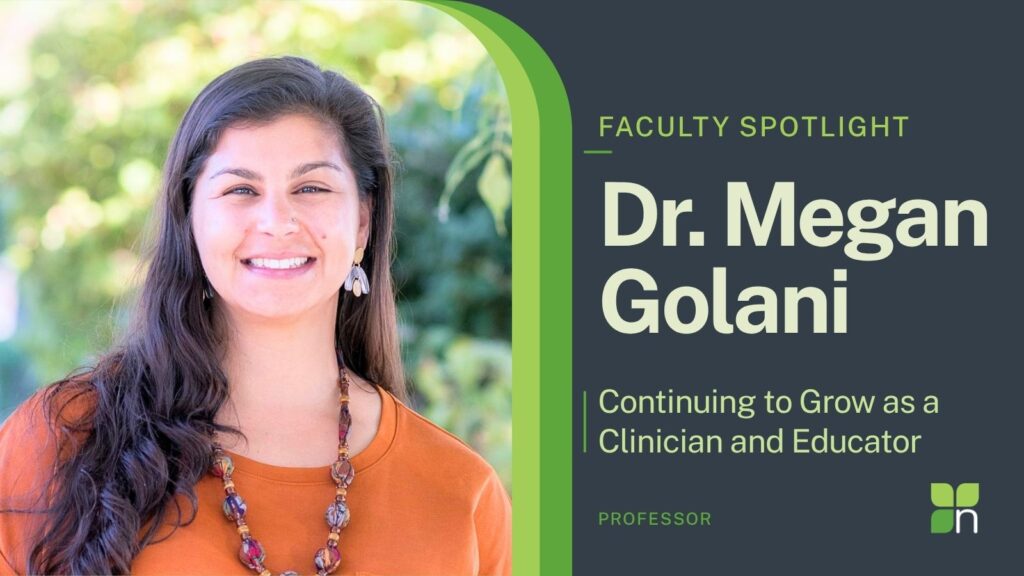
That idea sits at the heart of Megan Golani, ND, MAc’s approach to medicine and teaching. After more than a decade as an educator at National University of Natural Medicine (NUNM), Dr. Golani has been promoted to Professor, recognizing her contributions to clinical education, curriculum development, mentorship and integrative patient care.
Her path to the professoriate has been anything but one-dimensional. A naturopathic doctor, clinician, educator, licensed midwife and recent graduate of NUNM’s Master of Acupuncture program, Dr. Golani has built a career around seeing the connections between different parts of health rather than treating them as isolated pieces.
“Medicine is broken up into parts, and that’s not the reality of any of us coming in as a patient,” Dr. Golani says. “We’re not a part. We’re a sum.”
From the clinic to the classroom
Dr. Golani completed her three-year residency at NUNM, where community health was a major component and teaching was part of her training. Her clinical practice has since developed into broad primary care and integrative medicine work with patients across the lifespan.
Her background as a licensed midwife has also shaped how she thinks about health. Although she no longer practices midwifery, that training gave her a deeper understanding of the transitions people experience throughout their lives.
Today, her clinical interests include women’s and men’s health, pediatrics and geriatrics, gastrointestinal health, cardiometabolic health and nutrition. That breadth allows her to bring real clinical complexity into the classroom.
Rather than teaching students to think about patients as a collection of conditions, she encourages them to consider the whole person and the circumstances surrounding their health.
Teaching the life cycle through nutrition
Nutrition has been one of those connecting threads throughout Dr. Golani’s time at NUNM.
Dr. Golani has taught Lifecycle Nutrition in NUNM’s Master of Science in Nutrition program for more than a decade. More recently, she has taken a leading role in developing and integrating clinical nutrition education across the naturopathic medical curriculum. Her approach is intentionally broader than teaching students what nutrients do or which dietary recommendations correspond to a particular condition.
Students explore nutrition across the human life cycle, beginning with preconception and pregnancy and continuing through aging.
That life-cycle perspective reflects Dr. Golani’s broader approach to patient care. Health is not a snapshot. It is a story.
Now, as NUNM’s curriculum continues to evolve, Dr. Golani is helping develop more focused clinical nutrition education. The goal is to give students more opportunities to apply nutrition directly to patient care.
“By being able to have meaningful blocks with a set story, I think students will be able to really invest time with their patients in nutrition,” she says.
For students preparing for a career in naturopathic medicine, that means learning to see nutrition not as an isolated subject, but as part of the larger clinical picture.
When the professor becomes the student
Dr. Golani’s recent experience as an NUNM student gave her an unusual opportunity to examine education from the other side of the desk.
She was no longer Dr. Golani, the experienced naturopathic doctor teaching medicine. She was Megan, a student learning Chinese medicine and acupuncture alongside her classmates.
That shift offered a new perspective.
“I know medicine in the areas that I specialize in and that I’ve studied but there were things I didn’t know, and I had to be comfortable with that,” she says. Instead of seeing that as a weakness, Dr. Golani found it useful.
Being a student again reminded her that expertise does not mean having all the answers. It means being willing to keep learning.
It also gave her a firsthand understanding of what students experience when they enter an unfamiliar area of medicine. That perspective has influenced how she approaches her own classroom.
“Being a professor isn’t about having arrived at a point where you know everything,” she says. “It’s really about this commitment to growing and then bringing that back to my students and patients.”
That may be one of the most important lessons she models for students: “You can be confident in what you know while remaining genuinely curious about what you don’t,” she says.
The real goal is not memorization
Ask Dr. Golani what makes her proudest as an educator, and she does not point to a particular course.
She talks about watching students make the transition from learning medicine to thinking like clinicians.
Over the years, she has taught students at different stages of their NUNM education, giving her the opportunity to watch that development unfold. Early on, students may naturally focus on what they know or what has worked for them personally. Clinical practice requires them to move beyond that.
“One size doesn’t fit all,” Dr. Golani says.
Her goal is to help students recognize their own assumptions and learn to ask a different question: What does this particular person need?
That includes looking beyond the individual patient. Through her teaching on social determinants of health, Dr. Golani encourages students to recognize that health does not exist in a vacuum. Her work has focused on integrating social determinants of health into clinical education, so students learn to consider access, resources and lived circumstances as part of clinical decision-making.
For Dr. Golani, learning medicine means learning how to navigate that complexity.
The lessons that last
If students leave her classes remembering only a treatment protocol or pathophysiology lesson, Dr. Golani says she has missed an opportunity.
What she hopes they carry with them is curiosity, humility and the ability to reflect.
Real patients do not arrive with multiple-choice answers. Their histories are complicated, their circumstances change and new information emerges.
A good clinician needs to know the medicine but also needs to know how to think.
That is the transition Dr. Golani most enjoys watching.
She has even had the chance to see former students become colleagues. One recent graduate was someone she first encountered during the admissions process. Years later, she watched that student graduate and met the student’s family, who thanked her for supporting the student’s journey.
Those relationships are part of what makes teaching at NUNM meaningful to her.
“You get to work with students on their journey,” Dr. Golani says. “You get to know them in a way that I don’t think you get, especially at a larger school.”
What comes next
Dr. Golani’s promotion to Professor comes as both her career and NUNM’s curriculum continue to evolve.
She plans to keep developing clinical nutrition education, mentoring students and residents and exploring how her acupuncture training can inform her teaching and clinical practice.
For Dr. Golani, becoming a professor is not a finish line. It is another opportunity to keep learning and to help students become thoughtful, curious clinicians.
And perhaps that is the most fitting lesson she could bring to the classroom: knowing medicine matters, but knowing how to keep learning matters just as much.